
From the beginning, my day-to-day work was deeply rooted in digital marketing fundamentals: maintaining a healthy website, improving local visibility, and designing marketing materials that reflected the company’s reputation for quality and reliability. Over time, that work expanded into more advanced responsibilities such as CRM management, lead tracking, and workflow automations, all aimed at giving the team a clearer picture of how homeowners found and engaged with the brand.
Goals and challenges
When I arrived, Greenawalt’s website and digital presence already included a strong base of content, service descriptions, and regional pages, but there were numerous technical and structural issues that limited performance. Many landing pages and blog posts needed cleaner internal linking, updated copy, repaired images, and improved on-page SEO to reflect how homeowners actually search for roofing, siding, and exterior work in specific local markets.
At the same time, the company’s growth across multiple regions created operational challenges that touched every part of digital marketing roofing: tracking which landing pages generated leads, understanding which locations those leads belonged to, and making sure the internal teams could quickly see the context behind each opportunity. Moving to a new CRM platform introduced both an opportunity and a challenge—there was a chance to build stronger systems, but only if the structure, interface, and automations were tailored to the way the teams actually worked.
Process and key decisions
My work began with graphic design and website maintenance. I created print and digital marketing materials for advertisements, social campaigns, and educational content that aligned with Greenawalt’s visual identity. On the website side, I handled weekly updates that focused on site health: fixing broken links and images, refining page copy, improving metadata through tools like Yoast SEO, and strengthening internal links to help both users and search engines navigate more effectively.
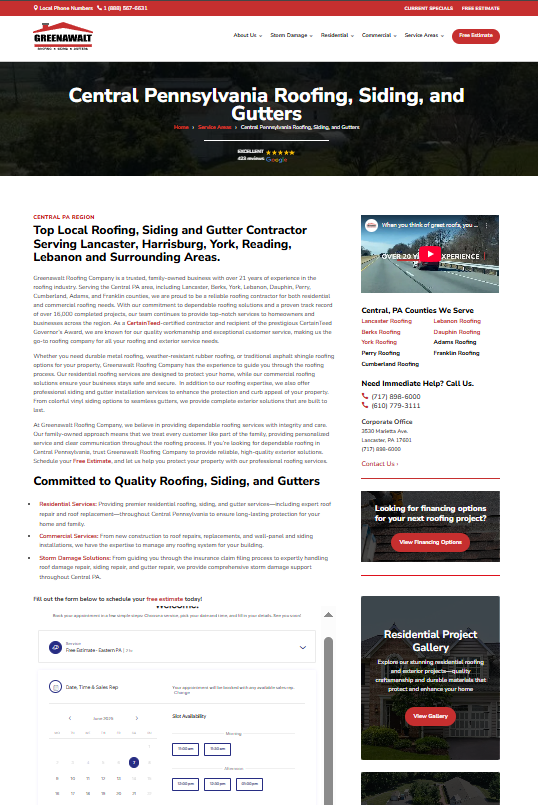
As we sought to improve local SEO, I supported the creation and maintenance of numerous local landing pages tailored to specific regions, counties, and towns across our service areas. These pages needed to be easy for homeowners to understand while also structured in a way that allowed search engines to recognize local relevance, which meant thoughtful use of headings, location references, and calls to action integrated with our broader Digital Marketing strategy.
Alongside the website work, I established a weekly social media calendar using tools such as Zoho Social, focusing on content that educated homeowners and showcased recent projects. Topics often included home maintenance tips, explanations of roofing and exterior options, and highlights from residential and commercial jobs, reinforcing the brand’s expertise and providing consistent touchpoints across multiple platforms.
Local SEO and tracking innovation
One of the most meaningful challenges I addressed involved tracking form submissions from our many local landing pages. Greenawalt Roofing relied on embedded JavaScript forms for website inquiries, which made it difficult to pass reliable page-level information into our CRM for reporting and lead-source analysis. Because we served so many distinct locations, understanding which specific landing pages were generating leads was critical for local SEO decisions, but the default setup did not easily capture that detail.
To solve this, I developed a custom WordPress plugin that transformed the JavaScript-embedded form into a reusable shortcode. The plugin allowed me to assign a unique title to each shortcode instance—such as “Pittsburgh Landing Page” or “York Landing Page”—and automatically wrote that title into a hidden form field on submission, reducing duplicate code on each page while consistently tagging leads with their originating landing page. This approach supported more accurate tracking of local campaigns and helped connect our digital marketing roofing efforts in content and local SEO directly to meaningful CRM data.
CRM management and automations
As the organization transitioned into a new CRM, my role expanded significantly into CRM management and workflow design. Initially, I assisted with foundational tasks such as updating fields and aligning the booking system with the team’s existing processes. Over time, this evolved into a broader remit that included creating more intuitive user interfaces, building crew portals, and defining user roles and permissions so that team members had clear, role-appropriate access to the information they needed.
A key project involved redesigning the interface of several CRM modules to better match the way sales, operations, and support teams worked day to day. I reorganized job content, contact details, and status information into cleaner layouts, with emphasis on clarity and quick access to essential data. To support operations across multiple locations, I also introduced color-coding for calendar events and lead entries based on region, making it easier to see job geography and travel considerations at a glance.
In parallel, I built a series of workflow automations to improve lead-source tracking. These automations connected information from our website forms, tracking phone numbers, and lead feedback so that each opportunity carried both a primary and a contextual source. The system set the primary lead source based on the form submitted or phone path used and also captured what leads said motivated them to reach out—for example, search engines, yard signs, or vehicle branding—allowing the team to compare the channel that delivered the lead with the touchpoint that left the strongest impression.

Growth within G1 Group
In January 2025, I was promoted to G1 Group, the parent company of Greenawalt Roofing, while continuing to support Greenawalt’s digital marketing initiatives. My responsibilities expanded to include work for another roofing brand within the group, focusing on website updates, SEO improvements, and broader marketing support that mirrored and extended the systems developed for Greenawalt Roofing.
Over the course of my time with G1 Group, my role shifted from a Multimedia Designer—concentrating on graphic design, video editing, and web design—into a core member of the marketing team with a stronger emphasis on lead tracking, CRM systems, and automations tailored to the roofing industry. This evolution reflected the growing importance of reliable data, efficient internal tools, and integrated Digital Marketing practices in a competitive, service-based market.
Results and impact
While specific metrics remain confidential, the combined effect of these projects was clear in day-to-day operations and decision-making. The website became easier to maintain, more structurally sound, and better aligned with how homeowners search for roofing and exterior services across multiple local markets. Content updates, improved internal linking, and targeted local pages supported stronger visibility and a smoother experience from initial search through contact.
Within the CRM, redesigned interfaces, region-aware views, and structured workflow automations gave the team better visibility into where leads came from and how they moved through the pipeline. The ability to distinguish between the channel that handled a contact and the touchpoint that motivated it provided a more nuanced understanding of marketing performance and informed future campaigns without relying on guesswork. Together, these changes strengthened the connection between digital marketing, local SEO, and operations in a way that supported both the office and field teams.
Reflection
Working in digital marketing roofing across Greenawalt Roofing Company and G1 Group reinforced how important it is to treat the website, CRM, and creative assets as parts of one connected system rather than isolated tools. Effective marketing in this industry is not just about attractive graphics or well-written blog posts; it also depends on accurate lead tracking, thoughtful CRM management, and automations that support both customer experience and internal efficiency.
These experiences also deepened my appreciation for local SEO and region-specific messaging. Serving homeowners across Lancaster, Pittsburgh, Cherry Hill, and surrounding areas required a careful balance between consistent branding and locally relevant content, supported by clear data and well-designed processes. That combination of strategy, design, and systems thinking now underpins the digital marketing work.